Mites and nosema wear a colony down gradually; foulbrood strikes at its most valuable asset, the brood. American foulbrood is also the one bee disease that brings a veterinary inspector to your apiary and puts every neighbour within several kilometres under quarantine. So a beekeeper needs not only to recognise the disease on the comb, but also to know what the law expects next.
Two diseases under one name
The word "foulbrood" covers two completely different infections that have only two things in common: both kill larvae and both smell.
- American foulbrood (AFB) is caused by the spore-forming bacterium Paenibacillus larvae. A young larva becomes infected when it swallows spores with its food, but it dies in the sealed cell. The spores are exceptionally tough: in old combs, honey and equipment they remain infectious for decades and survive boiling and ordinary disinfectants. The name has nothing to do with geography; the disease occurs worldwide.
- European foulbrood (EFB) is caused by the bacterium Melissococcus plutonius, which does not form spores. Larvae die in open cells, usually at 3–5 days of age, before capping. The disease is far less persistent, depends strongly on the condition of the colony and often flares up in spring, when there are few nurse bees and a lot of brood.
In both cases the bees themselves spread the infection inside the hive: house bees chew out dead larvae and then feed healthy ones. Between hives and apiaries the pathogen travels with drifting bees, swarms, robbing, purchased colonies and, most often of all, with combs and tools in the beekeeper's own hands.
American foulbrood: the signs
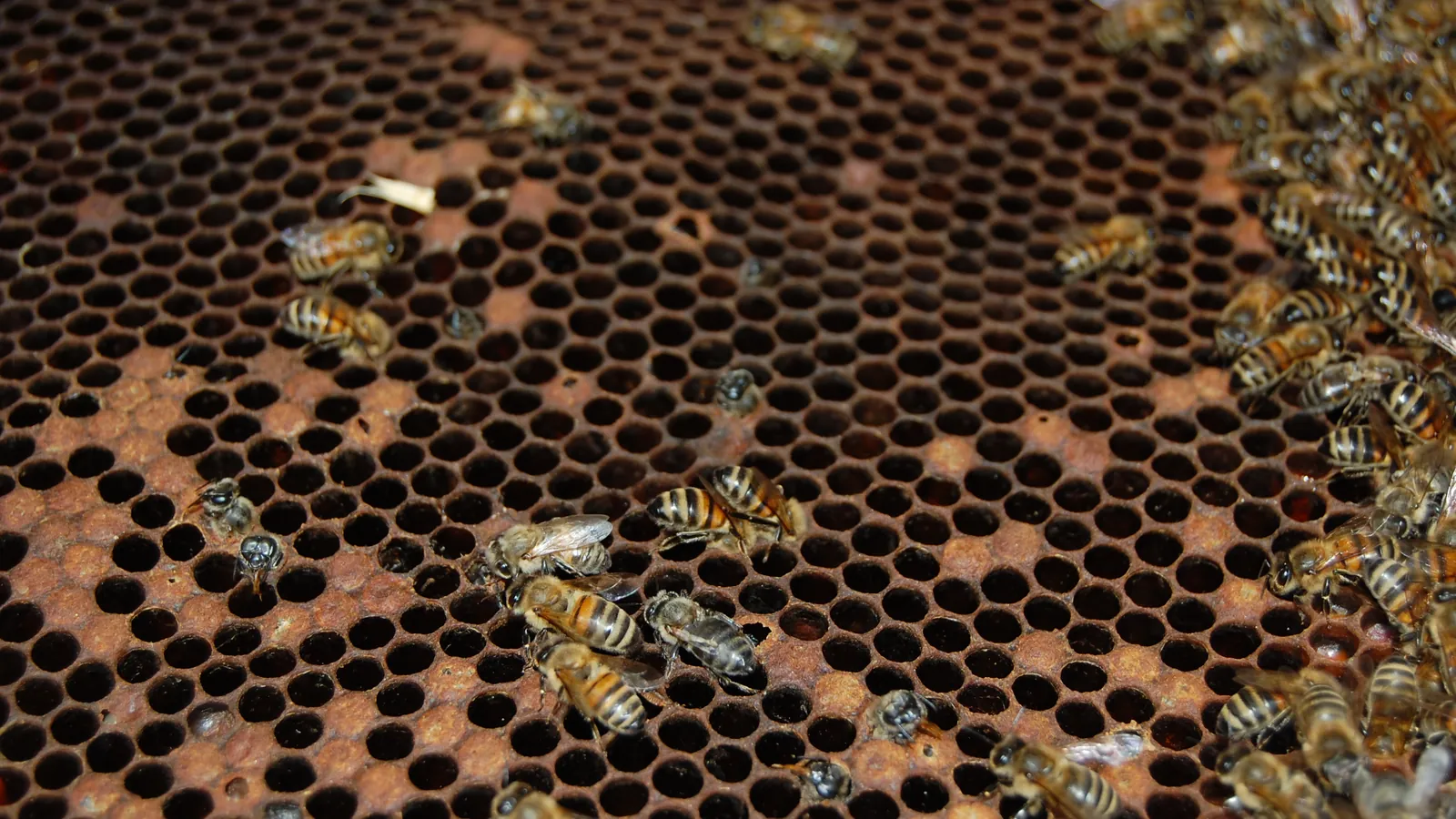
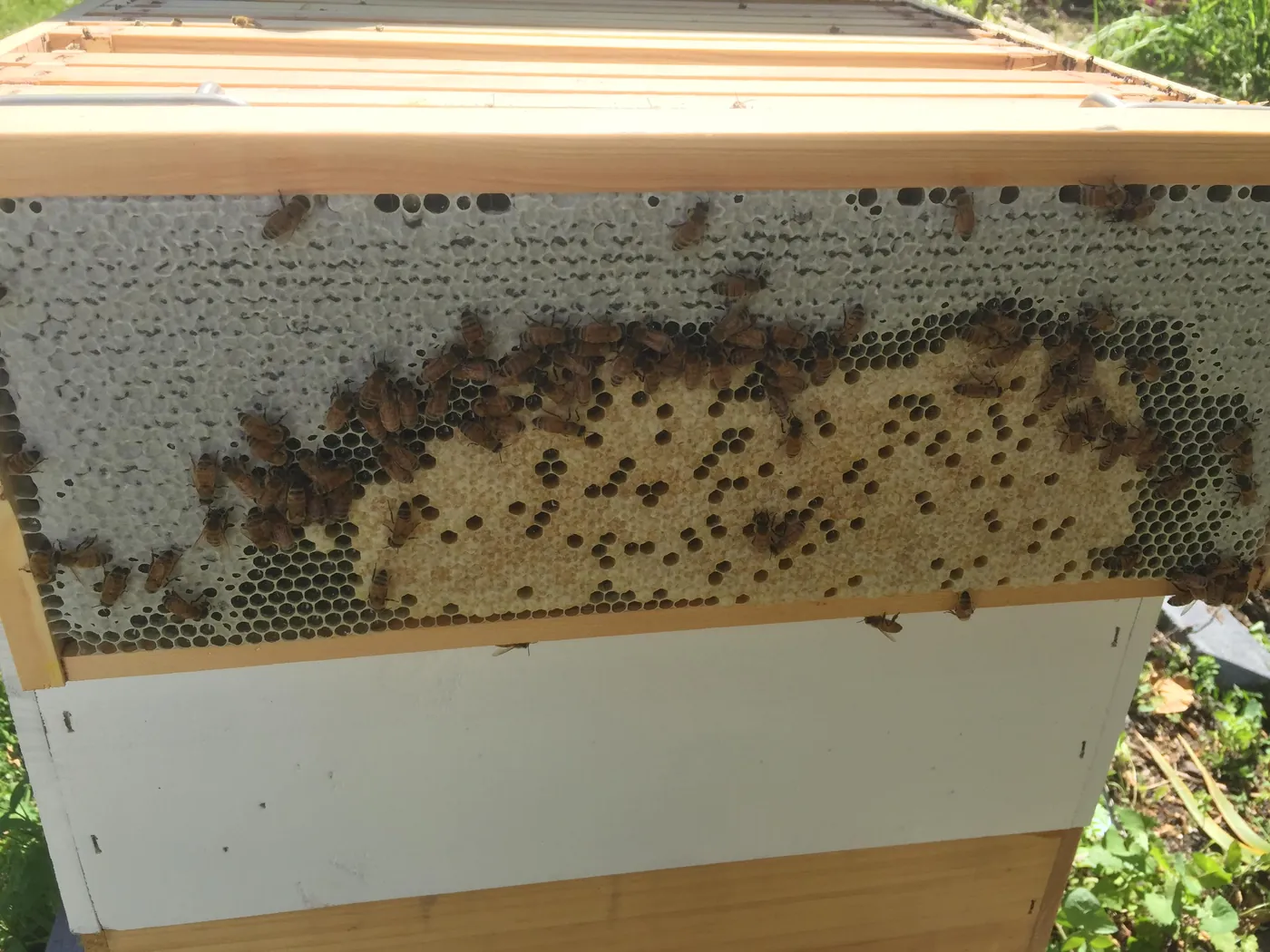
In the early stage the colony looks normal: bees are flying, the queen is laying. The first thing an attentive beekeeper notices is a patchy brood pattern: instead of a solid carpet of identical cappings, the comb shows gaps, cells of different ages and odd single cappings among healthy ones.
- Cappings darken, look moist, sink in and are often perforated: the bees start to open a cell with a dead pupa, give up, and leave a ragged hole.
- The larva under the capping turns from pearly white to dull yellow, then coffee brown, and dissolves into a uniform sticky mass that settles on the lower wall of the cell.
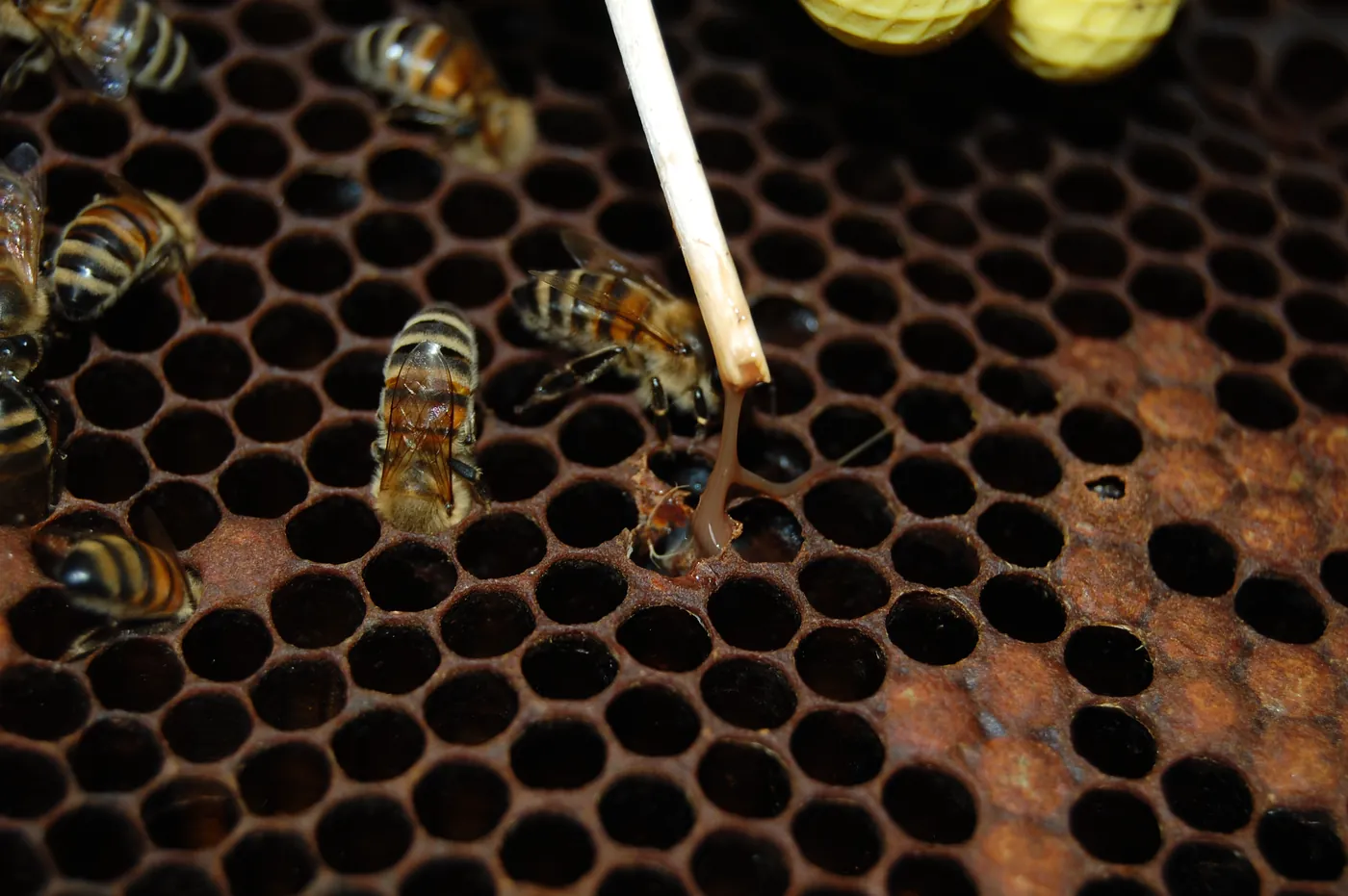
- The matchstick test. Open a suspicious cell with a matchstick or toothpick, touch the mass and pull slowly. With American foulbrood it stretches into a thin, sticky thread 2–3 cm long or more, like glue or melted caramel. No other brood disease produces such a rope.
- The smell is distinctive, reminiscent of animal glue or rotten fish; in a badly affected colony you can catch it at the entrance.
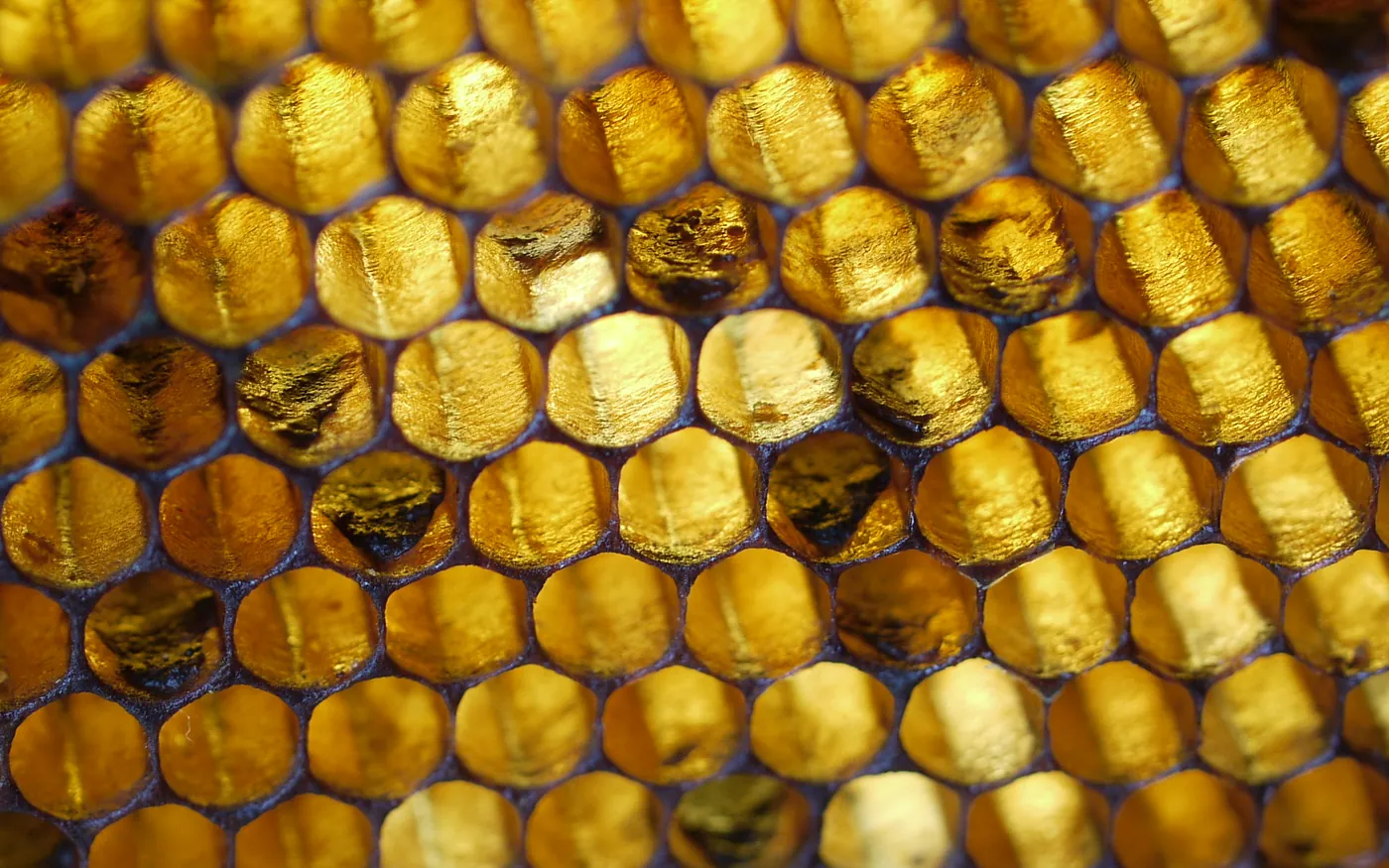
- Scales. After a few weeks the mass dries into a dark, almost black scale glued tightly to the lower cell wall. It is hard to remove even with tweezers, and the bees cannot remove it at all. Tilt the comb towards the light so you can look into the cells from above and the scales are easy to see. Sometimes a stretched-out "tongue" remains in the cell, the remnant of the dead pupa's proboscis.
European foulbrood: the signs
European foulbrood attacks open brood, and the picture is different. The beekeeper notices that the larvae in the cells are lying wrongly and unevenly.
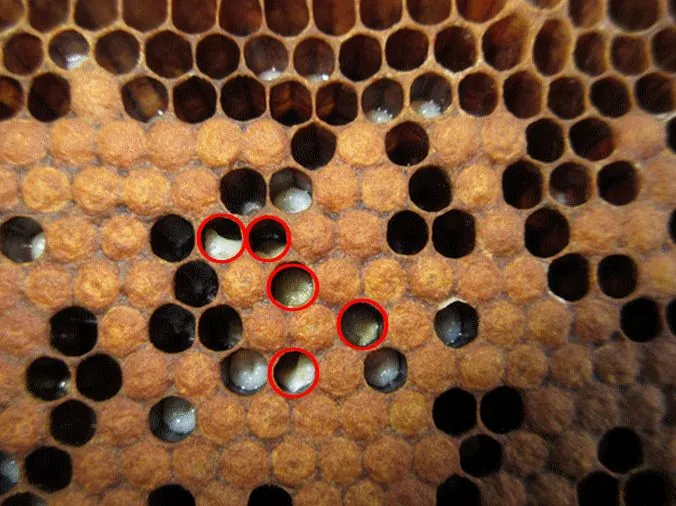
- A healthy larva lies on the cell floor as a neat white ring. A diseased one twists, uncoils, climbs the cell wall, takes unnatural positions and loses its plumpness.
- The colour changes from white to yellow, then greyish yellow and brown; the body goes flabby and the tracheae show through the skin.
- The smell is sour, like spoiled feed, sometimes with a putrid note depending on the secondary bacteria involved.
- The matchstick test does not rope, or barely: the mass is watery and granular.
- A dead larva dries into a soft, rubbery scale that the bees remove easily, so the comb often looks patchy simply because of empty cells.
- Some larvae survive to capping and die under the lid, producing sunken cappings as well, which can confuse the diagnosis.
The typical time for an outbreak is spring and early summer: the colony has a lot of brood but not enough nurses, the larvae are underfed and vulnerable. A strong colony with a good flow often "outgrows" the disease on its own; a weak one dwindles.
How not to confuse it with other brood diseases
Patchy brood and dead larvae occur with more than just foulbrood. The table helps separate four common causes.
| Sign | American foulbrood | European foulbrood | Sacbrood | Chilled brood |
|---|---|---|---|---|
| Cause | Bacterium P. larvae, spores | Bacterium M. plutonius | Virus | Cold, not an infection |
| Which brood dies | Sealed | Open (3–5 days) | Sealed and older larvae | Any, at the edges of the nest |
| Cappings | Dark, sunken, perforated | Mostly intact; many open cells | Perforated, sometimes opened | Opened by the bees, at the periphery |
| Larva | Uniform brown mass | Twisted, yellow, flabby | Fluid-filled sac with a dark raised head | Grey or black, intact |
| Matchstick test | Rope of 2–3 cm | Does not rope | Does not rope, comes out whole | Does not rope |
| Smell | Animal glue | Sour | Faint or none | Faint, sometimes sour |
| Scale | Hard, black, will not come off | Rubbery, easily removed | Boat-shaped, easily removed | None |
| When | All season, peak in summer | Spring, early summer | Spring, cold weather | After cold snaps, after expanding the nest |
Chilled brood clears up on its own once it warms up and the bees clean the cells. Sacbrood usually retreats with a good flow and a new queen. Foulbrood does not go away on its own, and American foulbrood is also a legal matter.
How to confirm the diagnosis
The matchstick test and the smell give a confident suspicion, but the final diagnosis is made by a veterinary laboratory. This is not a formality: the result decides what happens to your apiary and your neighbours'.
- Do not move frames between hives and do not unite colonies until you have an answer. Keep tools used on the suspicious colony separate.
- Cut a sample. A piece of comb about 10×15 cm with as many suspicious cells as possible and no honey. Wrap it in paper, not plastic: in an airtight wrapper the sample goes mouldy. Label it with the hive number and date.
- Hand it to the laboratory, yourself or through the district veterinary service. The lab will isolate the pathogen and, with American foulbrood, find the spores.
- A rapid test at the apiary. Kits exist for quick AFB and EFB diagnosis that work like a test strip: a drop of suspension from a diseased larva goes onto a cassette and the result shows in a few minutes. They are handy for first-pass sorting, but do not count as official confirmation.
- Write everything down: hive number, inspection date, what you saw, which frames you handled. The vet will need this to define the boundaries of the outbreak.
Quarantine and the law
In Belarus, Russia and the EU countries, American foulbrood is a disease that must be reported to the veterinary service. A suspicion is already reason enough to call: there is no need to wait until half the apiary is dead. The liability for spreading the infection to neighbouring apiaries is out of all proportion to the loss of a few colonies. European foulbrood is also registrable in a number of countries, but the measures are considerably milder.
What usually happens once the diagnosis is confirmed:
- The apiary is placed under quarantine, and a zone with a radius of several kilometres is defined around it. Inside the zone it is forbidden to move bees, queens, combs, honey for feeding or equipment in or out; the veterinary service inspects neighbouring apiaries.
- Heavily infected colonies are destroyed. The bees are killed, the combs, frames and insulation are burned, and hives and equipment are scorched or disinfected. It sounds brutal, but there is no other way to destroy the spores in the scales, and a diseased colony is a source of infection for the whole neighbourhood.
- Colonies with only a few affected cells may, in some countries, be treated by a shook swarm onto foundation: the bees are shaken into a clean, disinfected hive containing nothing but frames of foundation, kept without food for a day or two so they use up the contaminated honey in their crops, then fed syrup. The old brood combs are burned. In some countries this method is widely used, in others only destruction is permitted; the vet decides.
- Quarantine is lifted after a set period following the removal of the last diseased colony and final disinfection, usually after check inspections of the brood.

What to do about European foulbrood
Here the outlook is far better: the pathogen does not form spores, and a colony can deal with it on its own if given some help.
- Strengthen the colony. Add a frame or two of emerging sealed brood from a known healthy colony, reduce the nest, insulate, and feed if there is no flow. More nurses means better care of the larvae.
- Requeen. A 1–2 week break in egg laying gives the bees time to clean the cells, and a young queen often produces more hygienic offspring. Even simply caging the queen for a few days helps.
- Shook swarm onto foundation in severe cases, exactly as for AFB. Render or destroy the old combs with diseased brood.
- Remove the cause. EFB often flares up in damp hives, in colonies short of pollen or heavily infested with mites: check the mite load as described in the article on Varroa, and remember that nosema weakens precisely the nurse bees.
If the picture has not improved within a month of these measures, you need the laboratory: the "European" foulbrood may turn out to be American, or a mixed infection.
Disinfecting hives and equipment
The key difference between disinfection after foulbrood and an ordinary spring clean is that it must destroy spores. Plain washing and sunshine do not help here.
- Scorching. Wooden boxes, floors, roofs and frames (if they are to be kept) are scorched with a blowtorch or gas burner until the wood browns evenly, going carefully over joints and corners. Plastic hives cannot be scorched; they are washed with a hot alkaline solution.
- Caustic soda. A hot solution of sodium hydroxide dissolves wax and propolis well and kills the pathogens. It is used for metal tools, plastic and frames. Goggles and gloves are essential: the alkali burns skin and eyes. Rinse with water afterwards.
- Hydrogen peroxide and acetic acid. Mixtures based on them (peracetic acid) are sold as veterinary disinfectants and are effective against spores too. Use only registered products, following the label and its contact time.
- Small items. Hive tool, brush, smoker, gloves, swarm box, feeders: everything that touched the diseased colony is scorched or soaked in alkali. Cloth gloves and insulation are easier to burn.
The order of work: scrape off wax and propolis first, then disinfect. Fire will not reach spores hidden under a layer of propolis.
Honey and wax
Honey from diseased colonies must never be fed to bees, yours or anyone else's, nor left where bees can reach it. P. larvae spores are harmless to people, but during quarantine the use of honey from the outbreak is usually restricted; check with the vet. Wax from infected combs is not sterilised by home rendering: the spores survive the melting temperature. Brood combs from diseased colonies are burned, and combs without brood go for processing only with a note about the infection; wax plants hold the wax at high temperature under pressure. Buy foundation from makers who sterilise their raw material.
Prevention
Most foulbrood outbreaks are the result of someone's economy: old combs "in good condition", a cheap colony without papers, a bucket of bought honey for feeding.
- No bought honey for feeding, ever. Honey from a market or shop can contain AFB spores; it is one of the commonest routes of introduction. Feed your own honey from healthy colonies, or sugar syrup.
- Do not buy old combs or second-hand hives without scorching them. Drawn comb of unknown origin is a lottery where the prize is small and the loss is the whole apiary.
- Quarantine bought colonies and caught swarms. Keep them apart, at a distance from the main apiary, and inspect the brood 3–4 weeks after the first sealed brood appears. Buy bees with a veterinary certificate.
- Keep strong colonies. Hygienic bees open and remove diseased larvae before they become infectious. Unite or dispose of weak and queenless colonies; do not keep them "just in case".
- Prevent robbing. A colony that has died of foulbrood is a buffet of spores for the whole neighbourhood. Close the entrance of a dead colony at once and remove the combs.
- Renew combs. Replace about a third of the brood combs with foundation every year; cull dark old combs.
- Disinfect tools between apiaries, and scorch the hive tool after every suspicious colony.
- Inspect brood regularly, in spring after the first flights, at the height of the season and when arranging the nest for winter, and keep records. The timing is easy to check against the beekeeper's calendar, and the article on the bee colony explains how a colony allocates its nurses and why larvae can go short of food in spring.