A colony that looks strong in August can be an empty box with a handful of dead bees by March. Most often the culprit is the Varroa mite, a parasite the size of a pinhead. There is no need to fear it, but you do need to count it: a beekeeper who knows the mite load in each hive makes decisions based on numbers, not guesswork.
Meet Varroa destructor
Varroa destructor jumped to the western honey bee from the Asian honey bee, Apis cerana. Its original host learned to live with it over millennia; our honey bee has not. The mite reached western honey bees in the Russian Far East in the mid-20th century and spread across Europe in the 1970s and 80s, reaching North America in 1987. Today you will struggle to find a mite-free apiary anywhere in the temperate north.
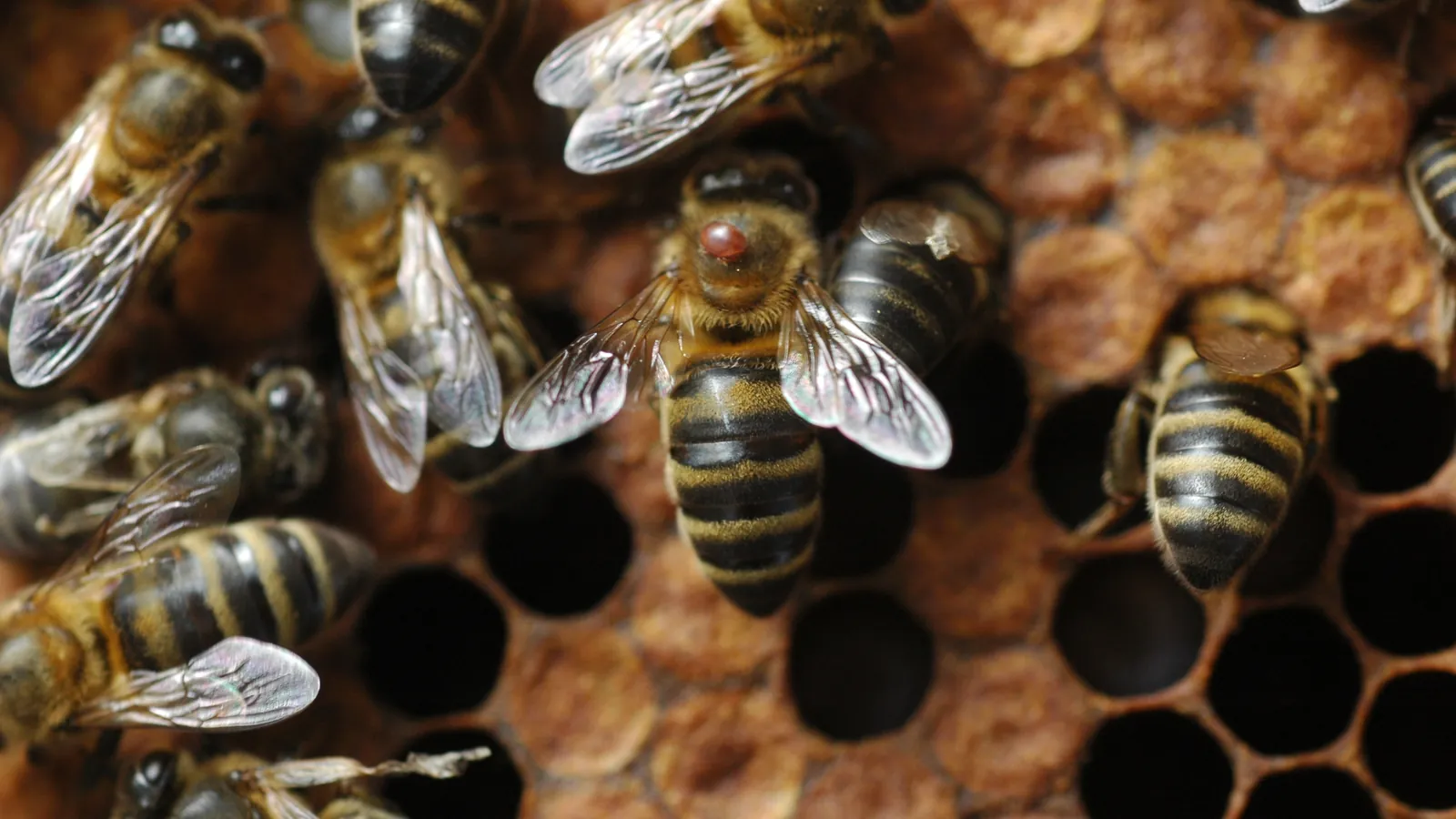
The adult female is oval, reddish-brown, about 1.1 mm long and 1.6 mm wide. You can see it with the naked eye on a bee's back, on the hive floor or on a mite board. Males and immature mites are pale, tiny and live only inside capped cells.
Breeding in capped brood
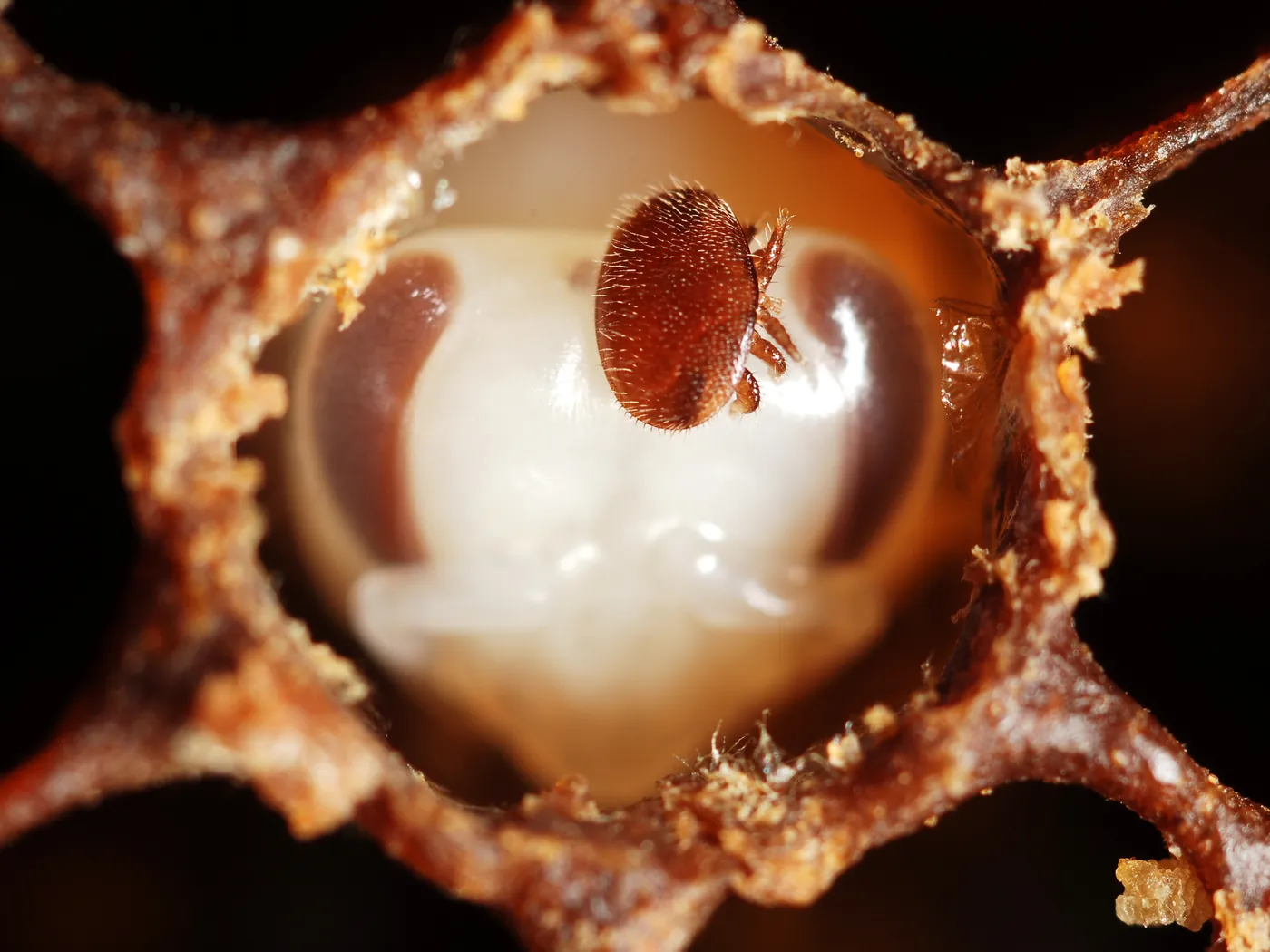
The mite's whole life revolves around brood. A female slips into a cell shortly before it is capped and hides in the larval food at the bottom. Once the cell is sealed, she starts feeding on the larva and laying eggs.
- 1–2 days before cappingThe female enters a cellShe enters drone cells earlier and far more readily than worker cells: drone larvae are bigger and take longer to develop.
- About 3 days after cappingFirst egg: a maleAfter that she lays a female egg roughly every 30 hours.
- Inside the cellMatingYoung females mate with their brother right in the cell while the pupa matures.
- Bee emergesMother and 1–2 daughters walk outA worker cell yields on average just over one mature daughter, a drone cell two to three. The male and immature mites die.
Between breeding cycles the mite rides on adult bees for several days. This is the phoretic (dispersal) phase. While a colony has plenty of brood, most mites, by various estimates two-thirds or more, sit inside capped cells, where neither the bees nor most treatments can reach them.
Why the mite is so dangerous
For decades textbooks said Varroa "sucks haemolymph". Research published in 2019 showed that its main food is the bee's fat body: tissue responsible for immunity, detoxification and nutrient reserves. For a winter bee, the fat body is the battery that has to last for months.
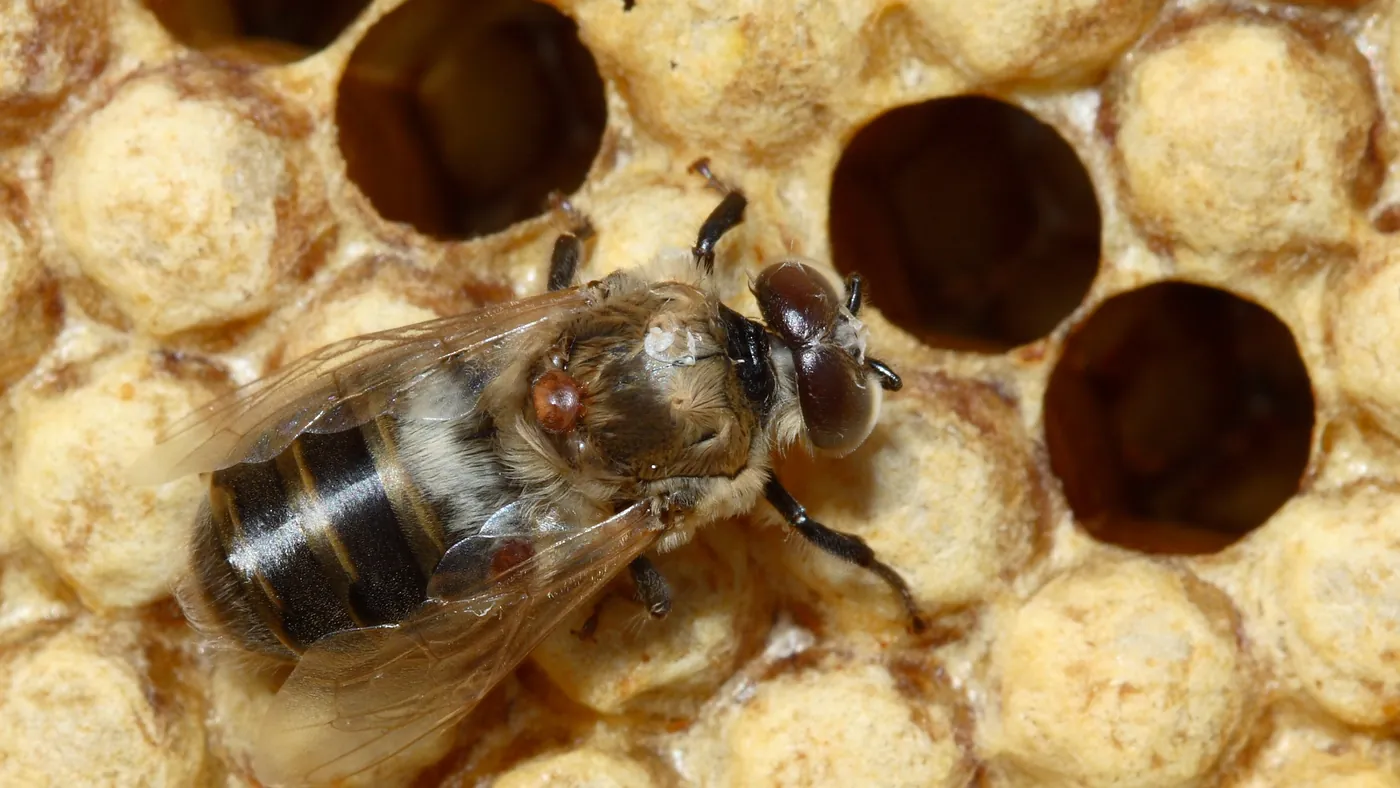
- Weaker bees. Bees parasitised as pupae emerge lighter, live shorter lives, navigate worse and more often fail to return home.
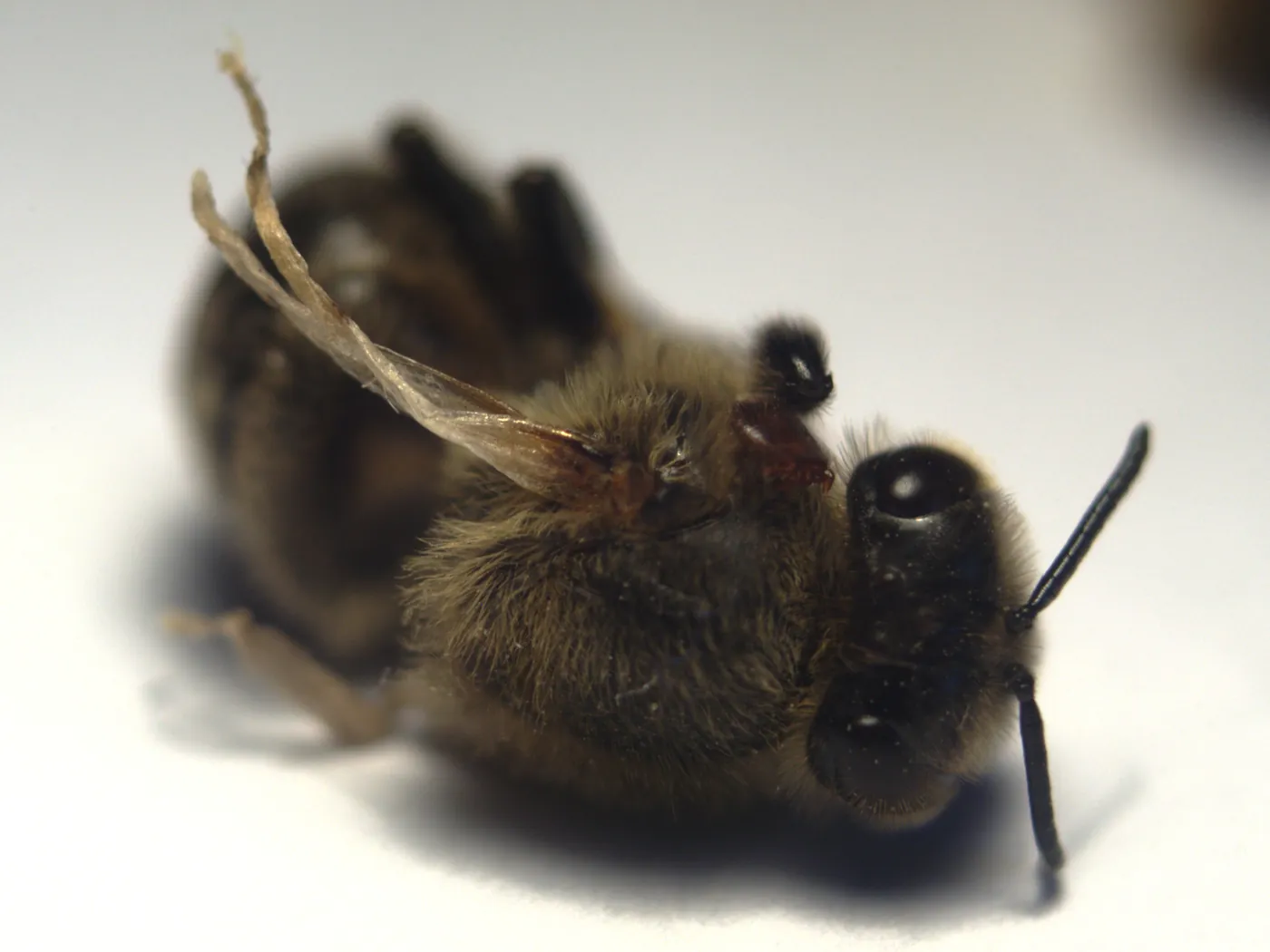
- Viruses. The mite carries and amplifies viruses, above all deformed wing virus (DWV), injecting them straight into the pupa's tissues and bypassing natural barriers.
- Short-lived winter bees. A bee that should live from autumn to spring dies within weeks if heavily infested.
Why colonies die in winter
Winter bees are raised from late summer to mid-autumn, exactly when the mite population peaks. If they develop in infested cells, the cluster shrinks through January and February, can no longer keep warm and dies with honey still in the combs. Large surveys such as the long-running German Bee Monitoring project found that high mite loads in autumn and deformed wing virus are leading factors in winter losses. More on getting colonies ready for the cold in our guide to overwintering bees.
How mites build up over a season
As long as there is brood, an untreated mite population roughly doubles every month, and faster still with lots of drone brood or mites drifting in from neighbours. In spring you have tens of mites; by late summer, thousands.
The most dangerous moment is late summer. The colony cuts back on brood, the bee population shrinks, and mites emerging from cells pile onto the remaining bees and crowd into the few brood cells left. Mites per hundred bees jump sharply, and this is exactly when the winter bees are being reared.
How to count mites
You cannot judge Varroa by eye. If you already see mites on bees or bees with crippled wings, the infestation has been high for a while. You need numbers, and there are three main ways to get them, from the simplest to the most accurate.
Natural mite drop
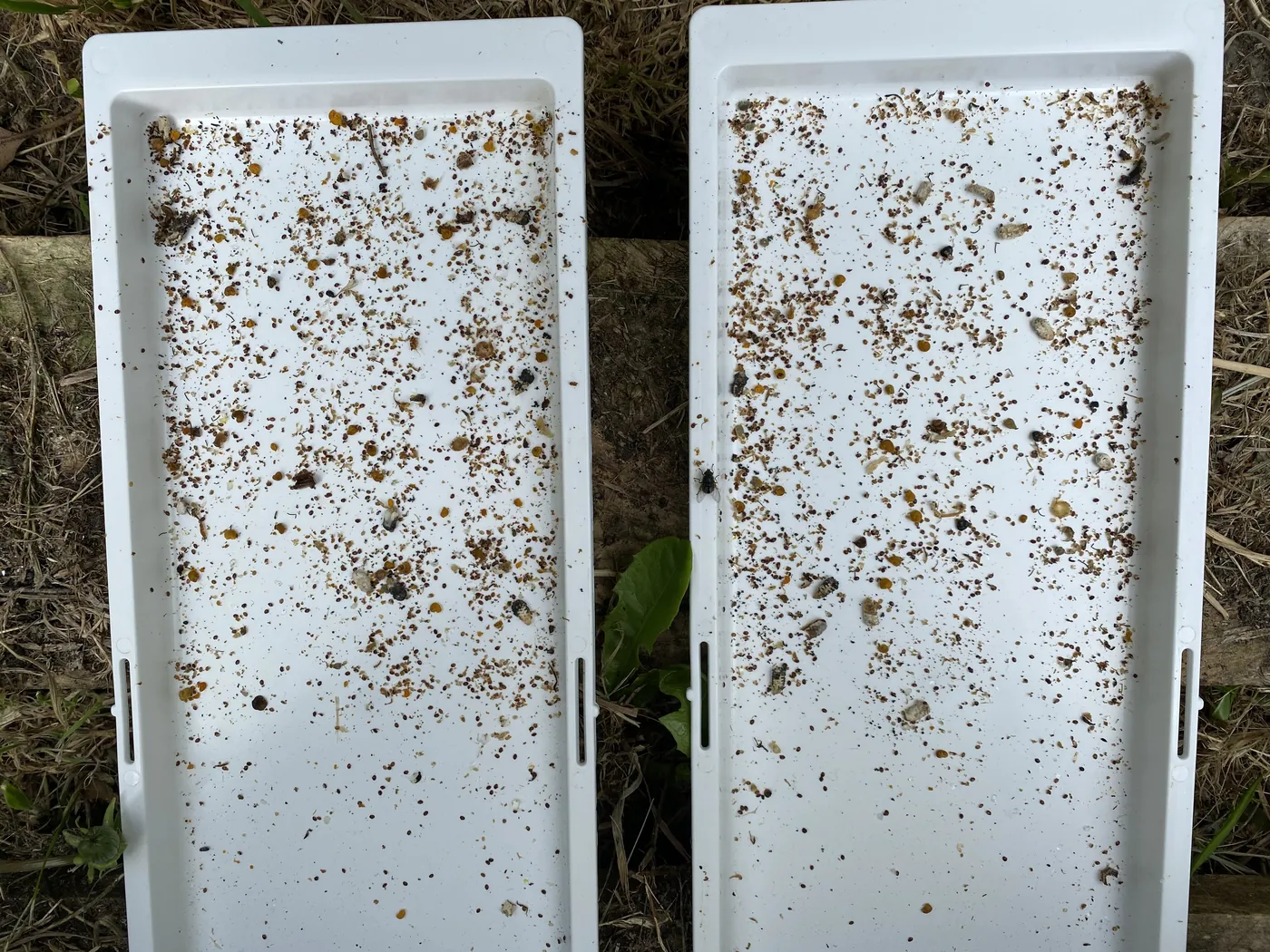
Slide a white board (plastic or card) under the screened bottom board. A thin smear of oil or petroleum jelly stops ants carrying mites away. After 3–7 days count the fallen mites and divide by the number of days. Do not leave the board longer than a week: mites become hard to spot among the debris.
The method does not require opening the hive and is good for tracking trends, but it is imprecise: the drop depends on colony strength, the amount of brood and the weather. Converting "mites per day" into the total population is only a rough estimate.
Sugar roll and alcohol wash
Both methods give you the key figure: the infestation rate, or mites per 100 adult bees. Take the sample from a frame of open brood, because young nurse bees carry the most mites. Always make sure the queen is not in the sample.
- Sugar roll. Dust the bees with powdered sugar in a jar with a mesh lid, roll for a couple of minutes, then shake the sugar and mites onto a light surface. The bees survive, but accuracy is lower: some mites stay on, especially in humid weather.
- Alcohol or soapy-water wash. Cover the bees with alcohol or water with a little detergent and shake. The bees die, but this dislodges the most mites and gives the least variable results. Three hundred bees is a tiny fraction of a colony of 20,000–50,000.
How to do an alcohol wash:
- Prepare the jar. Use a clear jar marked at half a cup (about 120 ml) with a mesh lid that lets mites through but not bees.
- Find the queen. Pull a frame of open brood from the brood box and check that the queen is not on it.
- Take the sample. Shake the bees into a tub and scoop them up to the line straight away. That is about 300 bees.
- Cover and shake. Pour in enough alcohol or soapy water to cover the bees, close the lid and shake vigorously for 1–2 minutes.
- Count the mites. Pour the liquid through the mesh onto a white plate and count. For better accuracy, repeat with fresh liquid.
- Work out the percentage. Divide mites by bees and multiply by 100. Nine mites in 300 bees = 3%.
| Method | Accuracy | Bees | Best for |
|---|---|---|---|
| Natural mite drop | Low, trends only | Unharmed | Ongoing monitoring, checking a treatment |
| Sugar roll | Medium | Survive | Small apiaries, dry weather |
| Alcohol / soap wash | High | ~300 bees die | Deciding whether to treat |
Thresholds: when to treat
Thresholds are guidelines, not law: they depend on region, colony strength and season. Good references are the Honey Bee Health Coalition's "Tools for Varroa Management" (8th edition, 2022) and the advice of European bee research institutes.
| Colony phase | No rush | Treat promptly |
|---|---|---|
| Broodless / winter | < 1% | > 1% |
| Spring build-up | < 2% | > 2–3% |
| Peak population (summer) | < 2% | > 3% |
| Decline (late summer, autumn) | < 2% | > 2–3% |
For natural mite drop, the Celle Bee Institute (LAVES, Germany) treats more than 10 mites a day in July as critical for production colonies and more than 5 for nucs. Switzerland's FiBL advises starting treatment as soon as possible if the drop is 5–10 mites a day at the end of July. In winter and early spring the benchmarks are much lower: even a few mites a day at that time is a warning sign.
Control methods
No single method removes every mite, so beekeepers combine them. Choose specific products and doses strictly according to the product label and the rules in your country: approved treatments differ between the EU, the UK, North America and elsewhere.
Management techniques
- Drone brood removal. Mites prefer drone cells, so you put in a foundationless frame, let the bees draw it and fill it with drone brood, then cut out and destroy the capped brood before the drones emerge. It works in spring and early summer and noticeably slows mite growth.
- A broodless break. Cage or confine the queen and after 3–4 weeks there is no capped brood left. Every mite is now on the bees, where an acid treatment can reach it.
- Splits. Making nucs and requeening also interrupt brood rearing and dilute the mites. A broodless nuc is easy to treat straight away.
Organic acids
- Oxalic acid works only on mites on adult bees; it does not penetrate capped cells. Use it in broodless periods: late autumn or early winter, in nucs, or after caging the queen. It is applied by dribbling (trickling solution between frames) or by vaporising (sublimation). Bees tolerate repeated dribbling in one season poorly.
- Formic acid is the only common treatment that partly reaches mites under the cappings. It is used in evaporators or pads, and both efficacy and safety depend heavily on temperature: in the cold it barely evaporates, in the heat it evaporates too fast and can harm the queen and brood. The working range is on the label.
- Thymol (an essential-oil compound) is used in warm weather, usually right after the harvest. It acts more slowly than synthetics and is also temperature-dependent.
Synthetic miticides
The active ingredients are amitraz (strips and, in some countries, fumigants) and the pyrethroids flumethrin and tau-fluvalinate (strips). They are convenient and very effective at first, but they have a serious downside: resistance. Pyrethroid-resistant mites have been widespread in Europe since the 1990s, and in recent years many regions have also reported declining efficacy of amitraz. Synthetics can also accumulate in wax.
The rule is simple: rotate active ingredients, not just brand names, since different brands often contain the same compound. Never raise the dose or leave strips in longer than directed; that only speeds up selection for resistant mites.
Check that the treatment worked
One to two weeks after a treatment ends, do another wash or monitor the natural drop. If infestation is still above 1–2%, the treatment failed, whether through resistance, weather or incorrect use. Do not repeat the same active ingredient; switch to a product with a different mode of action.
Reinvasion from neighbours
Even a perfectly treated apiary can pick up mites again in September. Strong colonies rob weak ones collapsing from Varroa, whether next door or in your own yard, and carry thousands of mites home on their bodies. Drifting drones and workers spread mites too.
- Do not skip the autumn check even if you treated in summer: test again in September–October.
- Prevent robbing: reduce entrances and never leave combs or syrup exposed.
- Do not nurse dwindling colonies into winter. Unite them with healthy ones only after testing and treating.
- Coordinate treatment dates with nearby beekeepers: treating at the same time across an area noticeably cuts reinvasion.
A season-long strategy
Treating "once a year by the calendar" no longer works. A more reliable loop is: count, decide, treat, check. See how it fits into the year in our beekeeping calendar, and why colony strength changes so much from month to month in the article on the honey bee colony.
- April–MayFirst wash on building colonies. Add drone frames and start drone brood removal.
- June–JulyDrone brood removal, splits. Monitor mite drop or wash before the main flow and in mid-July.
- Late July–AugustThe main summer treatment straight after the harvest. Check the result two weeks later.
- September–OctoberFollow-up wash for reinvasion; treat again if above threshold.
- November–DecemberOxalic acid in the broodless period, then count the mite drop.